

KPIs: Cash
Accounts receivable by age and money received over the last six months — what the outstanding figure counts, how an invoice is aged, and why an undated invoice is never overdue.
Per ora questo articolo è disponibile in inglese, francese e spagnolo. Stai leggendo la versione inglese. Français · Español
Cash — What you're owed, and what's actually come in. Two cards: Accounts receivable, by age, with the aging ladder under it, and Money received, last 6 months, a line of payments by month. Both are the dashboard's own figures — the same builder, the same rows — so this section and Home can never disagree about what is owed.
Receivables have no period: what you are owed is owed today, however old the invoice, so this is the one section the period buttons do not touch.
Overview
The outstanding figure is built from every invoice the company ever raised — every version — with drafts left out. Each invoice family is valued at its latest version, less every payment recorded against any version of it, so an amended invoice is never counted at the figure it was first raised at and a deposit taken on version one still counts against version two.
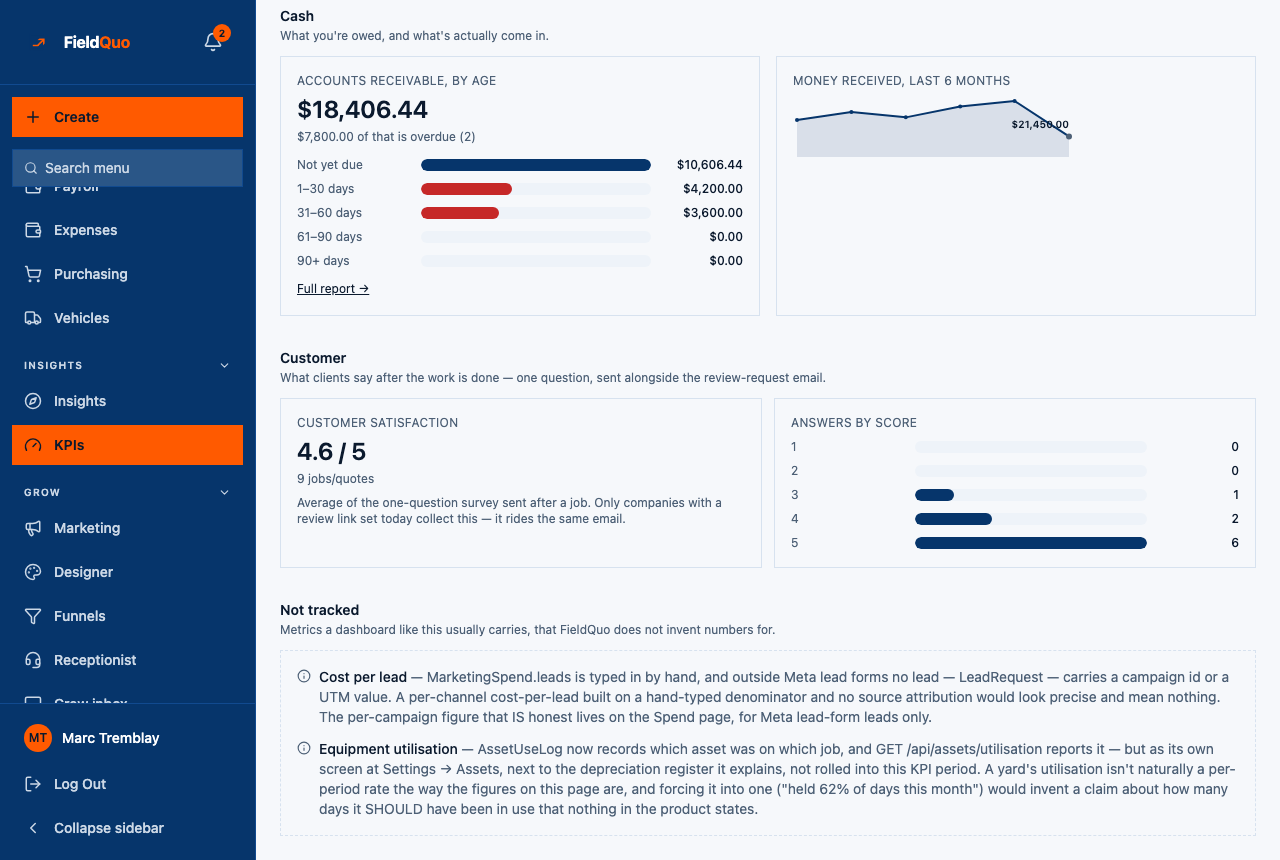
Accounts receivable, by age
The large figure is the total outstanding, then “{overdue} of that is overdue ({count})” or “Nothing outstanding right now.” Under it, the ladder — the same five rungs Home uses — with the past-due rungs in red, and a Full report → link to Financial statements.
| Rung | What lands on it |
|---|---|
| Not yet due | Outstanding, and the due date has not passed. |
| 1–30 days | Between one and thirty calendar days past the due date. |
| 31–60 days | Thirty-one to sixty days past due. |
| 61–90 days | Sixty-one to ninety days past due. |
| 90+ days | Ninety-one days or more past due. |
What the figure counts, and what it names
- Age is counted from the due date, in whole calendar days. An invoice with no due date is outstanding but never overdue and never on the ladder — it is a different statement, and Home lists it under No due date.
- An invoice with no date at all — never sent, no creation date — cannot be placed in time. It is counted and named rather than silently dropped, and the card shows the warning triangle when that happens.
- A payment recorded with an unparseable date is likewise counted as not placed and flags the figure.
- An overpaid invoice is a credit you hold, not money owed to you; it is kept out of the figure. Home says so with the amount.
- Three states, never one $0.00: a real balance, “Nothing outstanding right now.” when everything is settled, and “No invoices have ever been raised.” when there is nothing to be owed.
Money received, last 6 months
A line of payments by the month they were recorded, over the last six months, with the latest month's value labelled. It is the same series as Home's Money received chart on its 6m setting, built from the same payment rows.
- The current month is drawn as partial — it is not finished, and comparing it to a full month would manufacture a collapse on the 2nd of every month.
- A company that has never recorded a payment sees “No payments recorded yet.” rather than a flat line along the axis.
Who can see it
Part of the page's single gate — see The KPI dashboard: Manager, owners and administrators. The same figures, with the client's name and a Chase payment button on each invoice, are on Home for anyone with Invoices at View only and See prices — see Money owed and receivables aging.
Domande frequenti
Why does an old invoice with no due date not show as overdue?
Overdue is measured from the due date, and that invoice has none. Add a due date to it and it will age from there.
Why is the receivables figure the same whichever period I pick?
What you are owed has no period — a 2019 invoice nobody paid is owed today. The period buttons govern the other sections.
Why does the total not match the sum of the ladder?
The ladder holds only invoices with a due date. Undated invoices are in the total and named separately; overpaid invoices are in neither.
È stato utile?