

KPIs: Execution
On-time completion, labour utilisation and estimate accuracy — what each measures, what it deliberately does not, and the strip of recent jobs drawn from scheduled window to completion.
Поки що ця стаття доступна англійською, французькою та іспанською. Ви читаєте англійську версію. Français · Español
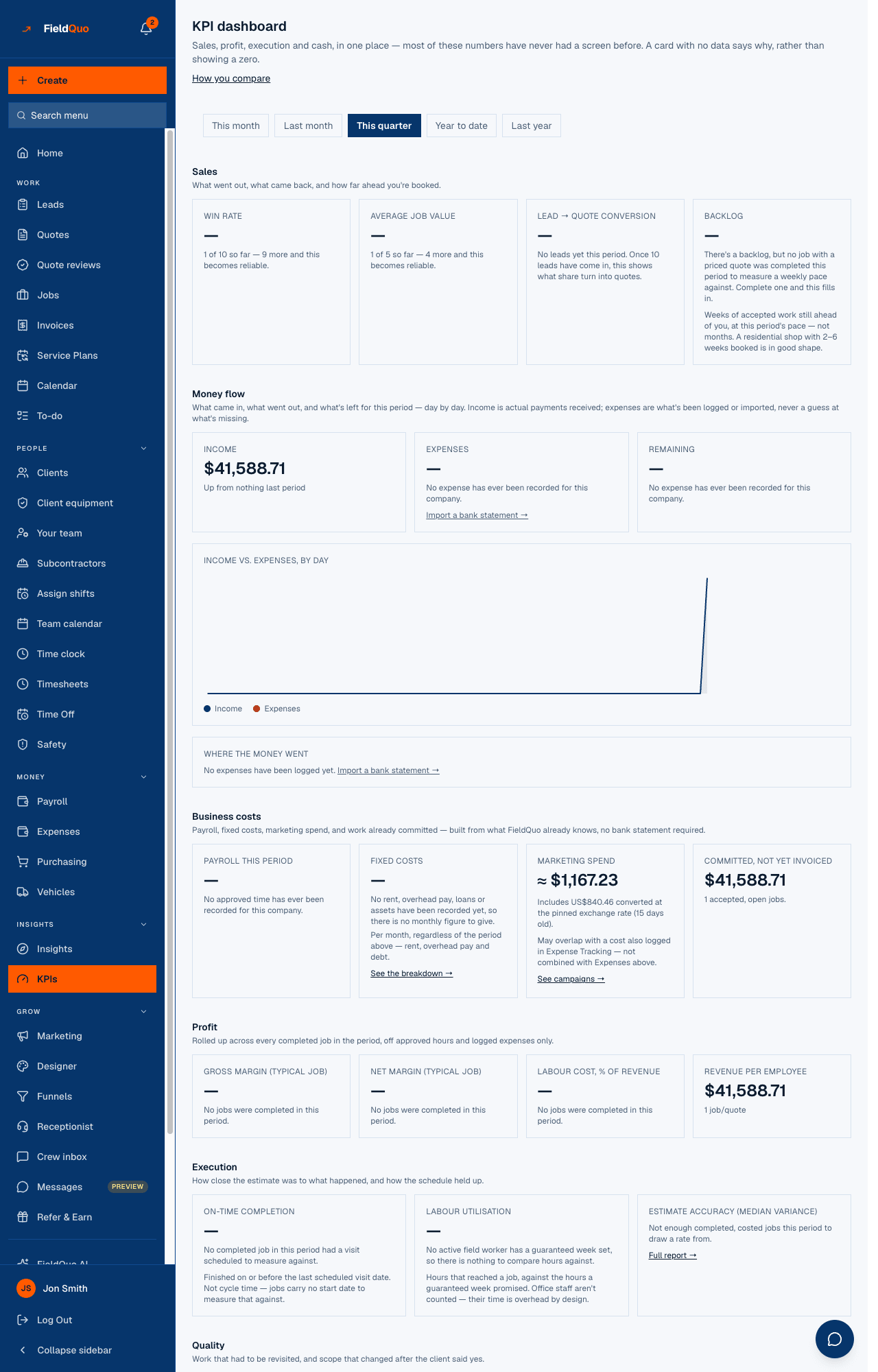
Execution — How close the estimate was to what happened, and how the schedule held up. Three cards — On-time completion, Labour utilisation, Estimate accuracy (median variance) — and under them a strip, Recent jobs: scheduled window vs. completion, one row per job.
Each card states on its face what it does not measure. On-time completion is not cycle time; utilisation is not a productivity score; estimate accuracy is a median, not a total.
Overview
All three read the jobs completed in the period, and two of them read the crew's approved hours. The utilisation card reads the guaranteed hours on each worker's record; without that, it has nothing to compare hours against and says so.
On-time completion
On-time completion is the share of completed jobs that finished on or before the date of their last scheduled visit. The hint says the rest: “Finished on or before the last scheduled visit date. Not cycle time — jobs carry no start date to measure that against.”
- The scheduled date is the visit's current date. A rescheduled visit is overwritten in place, so the date compared is the one actually agreed with the client — a job is not scored late for finishing exactly when it was told to.
- A completed job with no visit at all has no schedule to measure against; it is counted and excluded: “No completed job in this period had a visit scheduled to measure against.”
- It needs 10 measurable jobs before a percentage prints.
Labour utilisation
Labour utilisation is the hours that reached a job, over the hours the company guaranteed: approved job hours in the period ÷ (each field worker's guaranteed hours per week × the weeks in the period). The hint: “Hours that reached a job, against the hours a guaranteed week promised. Office staff aren't counted — their time is overhead by design.”
- Only workers with a guaranteed week on their record are in the denominator. With none: “No active field worker has a guaranteed week set, so there is nothing to compare hours against.”
- Office workers are excluded outright — asking what share of a bookkeeper's Tuesday belongs to a job is the wrong question.
- Hours from a worker with no pay rate are counted as hours but not as money; the card is marked incomplete and says how many workers it could not cost.
- The unabsorbed hours behind this rate — paid for, never on a job — are shown as money on Overhead and your minimum price. They are reported there and deliberately not yet added to your minimum price.
Estimate accuracy (median variance)
Estimate accuracy (median variance) is a small bar chart: for Labour hours, Labour cost and Materials and other job costs, the median of how far actual ran from the estimate, as a percentage — positive means over. A Full report → link opens the full Estimate accuracy report.
- It draws from completed jobs that carry both a costed quote and actual costs. Under 5 such jobs: “Not enough completed, costed jobs this period to draw a rate from.”
- A dimension is drawn only when it is reportable on its own sample; a dimension with too few jobs is left off rather than drawn thin.
- Positive bars are coloured as overruns, so a quick glance says which side you are missing on.
The schedule strip
Recent jobs: scheduled window vs. completion appears when at least one completed job had a visit: up to twenty rows, most recent first, each drawn from the first scheduled visit to the last, with the completion date marked and the row coloured Finished on time or Finished late. It is the same data the rate above was computed from, shown one job at a time.
Who can see it
Part of the page's single gate — see The KPI dashboard: Manager, owners and administrators. The guaranteed hours and the pay rate that utilisation reads are set per person on the team screens; the visit dates come from the job's visits.
Часті запитання
A job finished a day after its visit because the client asked for it. Is it late?
If the visit was rescheduled to the new date, no — the current visit date is what is compared. If the visit date was left as it was, yes.
Why does utilisation say there is nothing to compare?
No active field worker has guaranteed hours per week on their record. Set them on the person and the card fills in for periods after that.
Does utilisation change my minimum price?
Not yet. The unabsorbed hours are reported on the overhead screen and deliberately not folded into the burn rate until the figure has been believed for a while.
Чи була ця стаття корисною?