

Email Templates
Block-built email templates grouped Automated, Marketing and Custom — what the editor offers, which sends actually use them today, and what the Active badge does and does not change.
Settings → Documents & templates → Email Templates lists every email template your company has, grouped by what it is for, with one per type marked Active. Each template opens in a block editor with a subject line, your branding, merge fields, a live preview and a send-a-test button.
Read the next section before building one. Templates are genuinely sent by Follow-up rules and email campaigns. The Active badge on the automated quote and receipt types does not change what a quote or invoice email says today — those come from the document itself.
What is on the screen
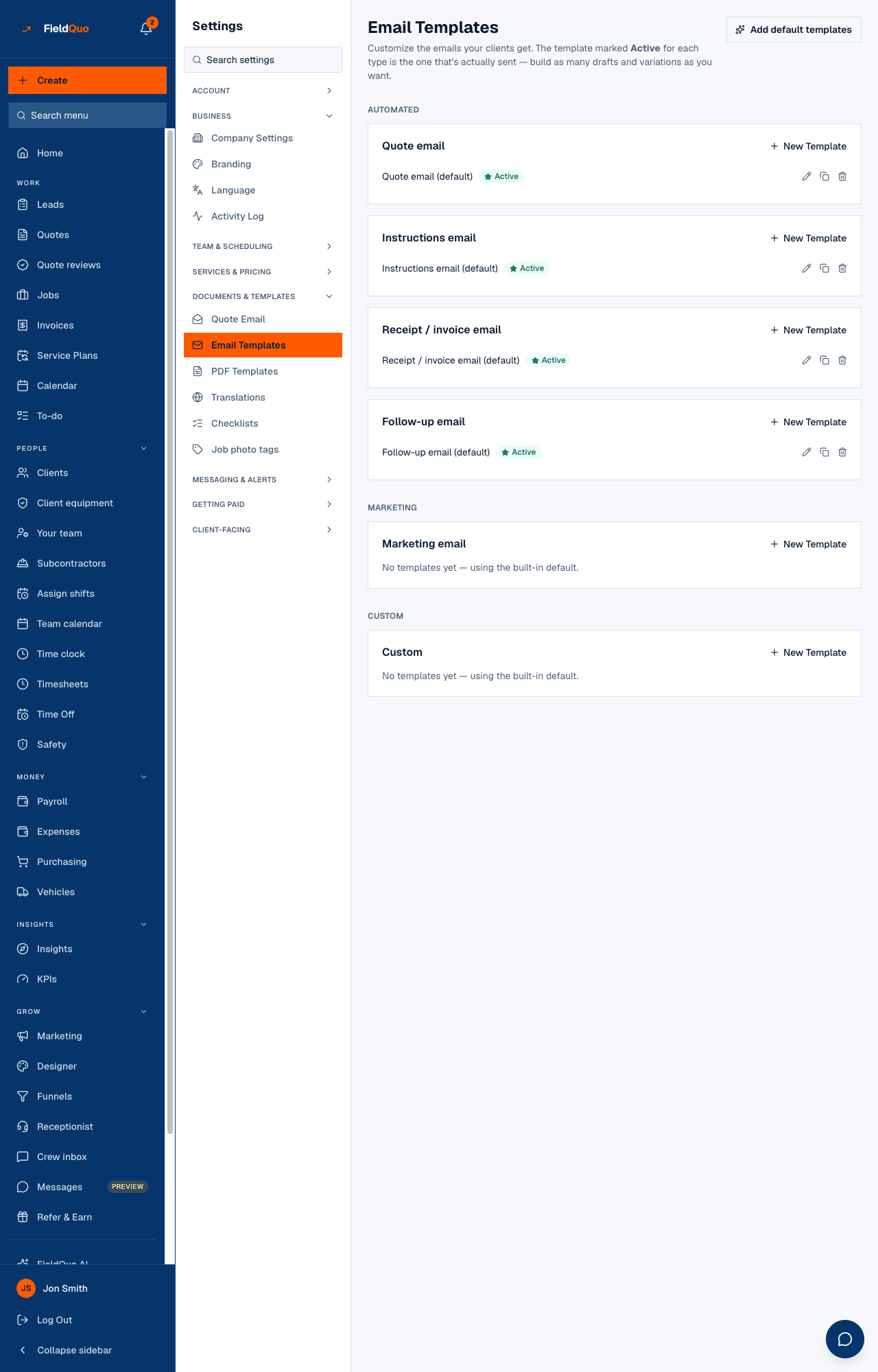
At the top, Add default templates, which seeds a starter template for each automated type you do not have yet. Then three groups — Automated (Quote email, Instructions email, Receipt / invoice email, Follow-up email), Marketing (Marketing email) and Custom — each type with New Template and its list of templates. A row shows the name, an Active badge on the one in use, a star to make another one active, and edit, duplicate and delete icons. A type with none reads No templates yet — using the built-in default.
Which sends use a template
| Template type | Used by |
|---|---|
| Follow-up email, Marketing email, Custom | Follow-up rules — a rule picks one of these when you create it, and the follow-up cron renders its blocks. See Follow-up rules. |
| Marketing email, Custom | Email campaigns on the Marketing screen — a campaign picks a template and sends it to your subscribers. See Email campaigns and subscribers. |
| Quote email, Instructions email, Receipt / invoice email | Nothing yet. The real quote and invoice emails are built from the document — its scope, inclusions and steps — and the layout under PDF Templates. Marking one of these Active moves the badge and changes no email. |
The wording of the quote email that IS yours to change lives elsewhere: per trade under Services & Pricing, and the two optional sections under Quote Email.
How to build one
- Press New Template under the type you need, give it a name and press Create & edit.
- Set the Subject line (merge fields work there too; blank uses the built-in subject for the type).
- Under Look & feel the template starts as Using your branding; change the accent, header and background only if you want to.
- Press Add block to add text, images, buttons, dividers or a summary, and drag blocks to reorder. Merge fields insert the client's name, the amount and so on.
- Check Email preview with sample data, on mobile and desktop, then Send a test to your own address.
- Press Save. Back on the list, press the star to make it the Active one for its type.
Delete is a hard delete with a confirmation. Deleting the Active template of a type returns that type to the built-in default.
Who can see it
Everyone can read templates, but every control — create, edit, activate, duplicate, delete, seed defaults — needs user:manage, so the row is shown only to owners, admins and supervisors rather than drawing buttons that would all be refused.
Frequently asked questions
I made a Quote email template Active and my quote email looks the same. Why?
Because the quote email is not rendered from a template today. Its wording comes from the quote and from Services & Pricing; the optional sections from Quote Email.
Do templates keep my logo and colour?
Yes. A new template starts as Using your branding, from Settings → Branding, until you customise its look.
Where do I choose which template a follow-up uses?
On the follow-up rule itself, under Settings → Follow-ups. Only Follow-up, Marketing and Custom templates are offered.
Was this helpful?